
November’s Read
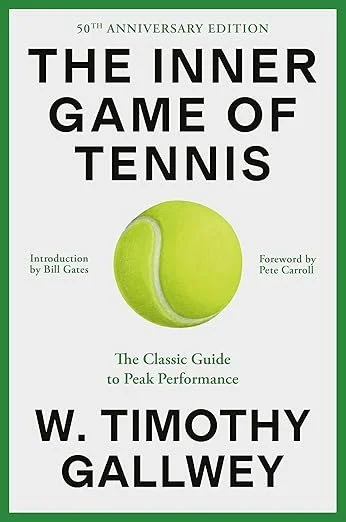
This month’s recommendation is “The Inner Game of Tennis: The Classic Guide to Peak Performance” by W.Timothy Gallwey.
About This Book
“This phenomenally successful guide to mastering the game from the inside out has become a touchstone for hundreds of thousands of people. Billie Jean King has called the book her tennis bible; Al Gore has used it to focus his campaign staff; and Itzhak Perlman has recommended it to young violinists. Based on W. Timothy Gallwey’s profound realization that the key to success doesn’t lie in holding the racket just right, or positioning the feet perfectly, but rather in keeping the mind uncluttered, this transformative book gives you the tools to unlock the potential that you’ve possessed all along.
“The Inner Game” is the one played within the mind of the player, against the hurdles of self-doubt, nervousness, and lapses in concentration. Gallwey shows us how to overcome these obstacles by trusting the intuitive wisdom of our bodies and achieving a state of “relaxed concentration.” With chapters devoted to trusting the self and changing habits, it is no surprise then, that Gallwey’s method has had an impact far beyond the confines of the tennis court.
Whether you want to play music, write a novel, get ahead at work, or simply unwind after a stressful day, Gallwey shows you how to tap into your utmost potential. In this fiftieth-anniversary edition, the principles of the Inner Game shine through as more relevant today than ever before. No matter your goals, The Inner Game of Tennis gives you the definitive framework for long-term success.”
My Thoughts
Timothy Gallwey’s Inner Game of Tennis explores a topic that is often only examined on a surface level: optimized learning. He provides frameworks for how we normally approach practice and performance, along with personal examples that offer vivid insight into what does not help us on the path to growth and, more importantly, what does.
He pulls back the curtain on our internal operating systems, shedding light on how often we let the conscious mind, ego, and constant self-judgment steer our efforts toward growth and outcomes.
He proposes that true growth emerges from a blend of non-attachment, a crystal-clear image of the desired outcome, acceptance and trust in the unconscious mind and the body’s ability to execute and improve through trial and error, and nonjudgmental observation of real changes and results, for better or for worse.
While Gallwey expresses these ideas simply, my own attempts to reach this state of mind when working on things I deeply care about feel more like swimming against a strong current. However, I believe that if your tolerance for discomfort is high enough, and your desire to succeed outweighs your desire for comfort, this state of mind becomes not only attainable but also deeply rewarding and fulfilling.
Want to give this title a read?
This title can be found here
About the Author
Jeremy Gibbens-Schneider is the head high performance coach and proud founder of Compound Performance.